Human Coagulation Factor VII Market Growth Supported by R&D in Biologics
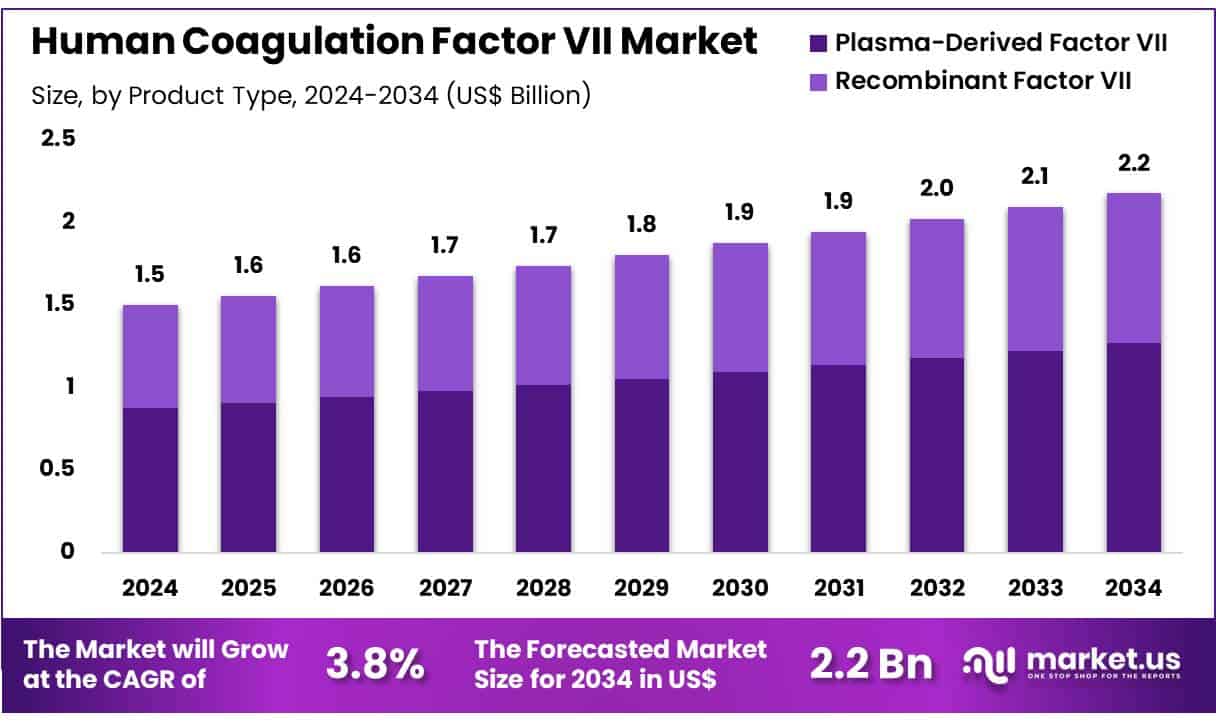
The Global Human Coagulation Factor VII market is projected to grow from USD 1.5 billion in 2024 to approximately USD 2.2 billion by 2034. This reflects a steady CAGR of 3.8% over the forecast period from 2025 to 2034. In 2024, North America held a dominant position, accounting for over 38.2% of the total market share, generating around USD 0.6 billion in revenue. The rising adoption of advanced treatments and broader healthcare access are contributing significantly to this growth.
Human Coagulation Factor VII is a crucial blood protein responsible for triggering the clotting process during injury. Though deficiencies are rare, they can lead to severe bleeding disorders that require timely medical attention. Hospitals are increasingly using Factor VII to manage bleeding during emergency trauma cases and surgical procedures. This rising application, especially in acute care settings, continues to support market expansion across developed and developing countries.
Public health initiatives have played a key role in boosting the market. Governments and global health agencies are promoting early diagnosis and subsidized treatment for rare blood disorders. These efforts are helping patients, especially in underserved regions, gain better access to Factor VII through public hospitals and national health schemes. In parallel, technological advances have led to next-generation products that are safer, longer-lasting, and easier to handle in medical settings.
Another key growth driver is the increasing awareness around bleeding disorders. Educational campaigns are helping both patients and physicians detect symptoms early. This has improved diagnosis rates and the overall management of the condition. As a result, more individuals are receiving regular treatment, leading to a rise in demand for Factor VII-based therapies. Together, these factors are shaping a positive outlook for the market through 2034.
Key Takeaways
- In 2024, the human coagulation factor VII market earned US$ 1.5 billion and is projected to hit US$ 2.2 billion by 2034.
- The market is growing at a compound annual growth rate (CAGR) of 3.8% during the forecast period from 2025 to 2034.
- By product type, plasma-derived factor VII led the market in 2023, accounting for a dominant share of 58.3%.
- When segmented by application, hemophilia treatment took the lead with a substantial 66.2% market share.
- Among end users, hospitals were the top contributors, generating 69.5% of the total revenue in the market.
- North America emerged as the leading regional market in 2023, holding a significant share of 38.2%.
Get sample report: https://market.us/report/global-human-coagulation-factor-vii-market/request-sample/
Challenges
- Unpredictable Symptoms: People with FVII deficiency may experience very different symptoms, even if their factor levels are similar. Some have no bleeding at all, while others suffer from serious episodes. This makes it hard for doctors to predict who needs treatment and how much.
- Development of Inhibitors: In some cases, the body can develop resistance to treatment by creating inhibitors—special proteins that block the effect of FVII replacement therapies. When this happens, it becomes difficult to control bleeding, and patients may need alternative, more complex care.
- Treatment Risks: Some treatment options, like plasma-based therapies, can carry risks. These include infections and other side effects. Recombinant therapies (lab-made treatments) are safer in many ways, but they can sometimes lead to complications like unwanted blood clotting.
- Limited Access and High Costs: Advanced therapies for FVII deficiency are not easily available in many parts of the world. Cost remains a big hurdle, especially for people in low-resource settings. This limits access to life-saving care.
Opportunities
- Genetic Research: Studies into the genetic causes of FVII deficiency are helping scientists find better ways to predict and treat the condition. In the future, this could lead to personalized care that is more effective and easier to manage.
- Recombinant Therapy Advancements: New recombinant FVII products are being developed with better safety profiles and improved stability. These therapies offer a cleaner and more targeted way to manage bleeding episodes without many of the risks linked to older treatments.
- Biosimilars and Local Production: More countries are beginning to produce biosimilar versions of FVII therapies. These options can reduce treatment costs and improve supply chains, especially in regions with limited access to imported medicines.
- Emerging Gene Therapies: Ongoing research is exploring the possibility of gene therapy to treat FVII deficiency. This approach could offer long-term or even permanent solutions by correcting the problem at the genetic level.
Conclusion
In conclusion, the Human Coagulation Factor VII market is showing steady growth, driven by rising awareness, better diagnostic tools, and improved access to care. The increasing use of advanced therapies in hospitals and support from public health programs are helping more patients receive timely treatment. Although challenges like treatment costs and symptom unpredictability remain, ongoing innovation in recombinant therapies, gene research, and biosimilar development is creating new opportunities. As healthcare systems expand and technology advances, more effective and safer treatment options are becoming available. With continued focus on education, early diagnosis, and personalized care, the market is expected to maintain a positive outlook in the years ahead.
Contact us on
Market.us (Powered By Prudour Pvt. Ltd.)
Email: inquiry@market.us
Address: 420 Lexington Avenue, Suite 300,
New York City, NY 10170, United States
Tel: +1 718 618 4351


Comments
Post a Comment