AI In Healthcare Market Forecasted to Grow Rapidly to US$ 696 Billion by 2034
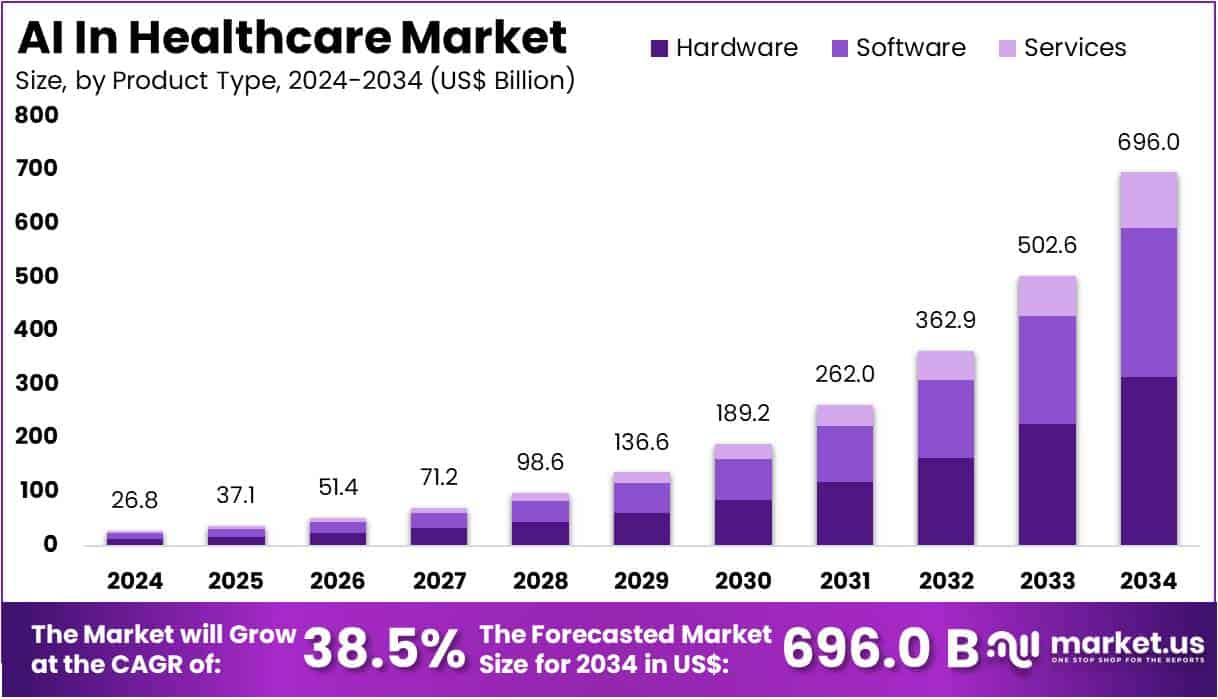
The Global AI in healthcare market is projected to grow from US$ 26.8 billion in 2024 to US$ 696.0 billion by 2034. This marks a strong CAGR of 38.5% during the forecast period. One of the main drivers of this growth is the rapid increase in healthcare data. Hospitals are now collecting electronic health records, imaging data, lab results, and wearable device information. With this expanding data volume, AI systems are becoming more accurate in diagnosis, prediction, and clinical decision-making. WHO confirms data availability as a key enabler of AI adoption in healthcare.
Another factor boosting AI growth is the global shortage of healthcare workers. In many regions, there are not enough doctors, nurses, or specialists to meet patient needs. AI supports healthcare delivery by handling routine administrative tasks, processing patient information, and assisting with clinical decisions. This allows medical staff to focus on complex cases. WHO and global health bodies emphasize that AI can help reduce workforce pressure and improve patient outcomes when used properly.
Technology advances are also playing a big role. Recent AI innovations are improving applications in diagnostics, surgery planning, and remote monitoring. These tools are becoming easier to deploy in hospitals and labs. At the same time, more governments are supporting AI through digital health strategies and public investments. WHO has released global guidelines to ensure ethical and safe use of AI in medical care. This alignment between technology and policy is speeding up adoption.
Post-pandemic, remote care tools have gained traction. AI-powered mobile apps and virtual platforms are helping patients track symptoms, receive care advice, and manage chronic conditions. These tools are more personalized and proactive, thanks to AI. At the research level, AI is helping speed up drug development and vaccine planning. Global partnerships between governments, research institutes, and tech companies are helping train staff and develop AI solutions responsibly, with a strong focus on fairness, safety, and public trust.
Key Takeaways
- In 2024, the AI in healthcare market generated US$ 26.8 billion, and it's projected to hit US$ 696.0 billion by 2034.
- The market is growing at a remarkable CAGR of 38.5% from 2025 to 2034, indicating rapid adoption across healthcare systems worldwide.
- In terms of product type, hardware led the segment in 2024, capturing a 45.3% market share due to increased demand for AI-enabled devices.
- When categorized by technology, machine learning dominated in 2024 with a 46.2% share, proving essential for data analysis and predictive healthcare models.
- Among AI applications, robot-assisted surgery took the top spot, accounting for 25.4% of market revenue thanks to its precision and growing usage.
- Looking at end users, healthcare companies held the largest revenue share at 50.5%, showing their leading role in implementing AI-driven solutions.
Get sample report: https://market.us/report/ai-in-healthcare-market/request-sample/
Emerging Trends
- AI That Listens and Writes Notes: One of the biggest changes in hospitals and clinics is the use of artificial intelligence to help doctors write medical notes. This kind of AI listens during patient visits and automatically writes clean, accurate summaries. It saves doctors a lot of time and reduces paperwork stress.
- Smarter AI That Understands More Than Text: AI systems are now being trained to work with many types of data not just text, but also images, speech, and even medical scans at the same time. These “multimodal” AIs help doctors by combining all of this information to make smarter suggestions during diagnosis and treatment.
- Remote Monitoring With AI: More hospitals and home care services are now using AI to track patients' health from a distance. Wearable devices collect information like heart rate, sleep, or oxygen levels, and AI watches for warning signs. This helps catch problems early, without needing a hospital visit.
- Growing Trust in AI: Doctors and health organizations are beginning to trust AI more. Many now see AI as a long-term tool not just a trend. The focus has shifted from “Is it safe?” to “How can we use it well?” This includes training staff and integrating AI smoothly into daily medical workflows.
Use Cases
- Helping Doctors With Medical Notes: AI assistants now listen in on doctor patient conversations and automatically create medical summaries. This makes doctor visits smoother and allows medical staff to focus more on patient care than typing notes.
- Predicting Health Problems Early: Some AI programs are trained to look at a person’s past health records and guess which diseases they might develop in the future. This gives doctors a chance to start treatments or recommend lifestyle changes before the illness gets worse.
- Tracking Patient Recovery at Home: When patients leave the hospital, AI can help monitor them at home. Smart devices can send updates about their health, and AI checks the information for warning signs. This improves patient safety and makes home care more reliable.
- Managing Medications in Hospitals: AI is used in hospital pharmacies to organize and prepare medicines. These systems reduce human error, ensure correct doses, and make the process faster. Some smart pillboxes and tracking tools also remind patients to take their medicine on time.
Conclusion
AI in healthcare is changing how medical care is delivered and managed. It helps doctors work faster, supports early diagnosis, and improves treatment plans. With growing amounts of health data, AI systems are getting smarter and more useful in daily hospital work. Governments and health organizations are now more open to using AI tools, especially for remote care and medical research. Even though there are concerns about privacy and fairness, ongoing efforts are being made to make AI safe, transparent, and helpful. As the technology becomes more advanced and trusted, AI will continue to play a bigger role in making healthcare more accurate, personal, and efficient for both patients and providers.
Contact us on
Market.us (Powered By Prudour Pvt. Ltd.)
Email: inquiry@market.us
Address: 420 Lexington Avenue, Suite 300,
New York City, NY 10170, United States
Tel: +1 718 618 4351


Comments
Post a Comment