US Medical Billing Outsourcing Market Forecasted to Reach USD 19.7 Billion by 2034
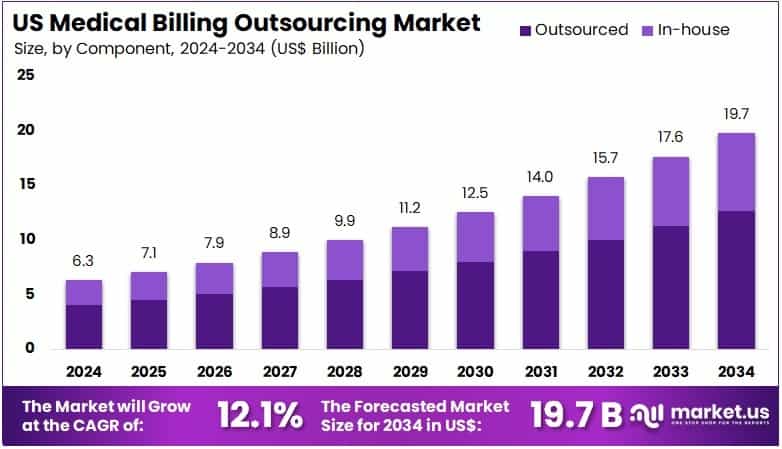
The U.S. medical billing outsourcing market is projected to grow from USD 6.3 billion in 2024 to USD 19.7 billion by 2034, registering a CAGR of 12.1% during the forecast period. One of the primary drivers of this growth is the rising administrative burden in healthcare. Providers face increased paperwork, insurance claims, and coding responsibilities. These tasks require trained staff and can distract from core clinical care. As a result, many hospitals, clinics, and private practices are outsourcing billing tasks to reduce workload and focus on patient outcomes.
The complexity of medical billing and regulatory compliance is also pushing demand for outsourcing. U.S. healthcare providers must follow strict rules, such as those under HIPAA, and navigate ever-changing medical coding systems. Frequent updates in codes and billing standards require deep expertise. Outsourcing to billing companies ensures accuracy, compliance, and faster reimbursement. These specialists are well-versed in regulatory changes, helping providers avoid claim denials and payment delays.
The shift to digital health records has added more complexity to the billing process. Electronic Health Record (EHR) systems improve data access and efficiency but demand seamless integration with billing platforms. Outsourced billing services offer advanced tech solutions that can connect easily with EHRs, reducing errors and improving speed. Many firms also use automation and cloud platforms, further boosting billing accuracy and transparency.
The move toward value-based care and the expansion of telehealth are reshaping billing practices. New care models focus on quality, not just quantity, requiring detailed performance tracking and new documentation methods. Telehealth billing involves unique codes and policies, making it more complicated for in-house teams. Outsourced billing experts can handle these newer models efficiently. Additionally, small and remote practices benefit greatly from outsourcing since they often lack in-house billing resources. This trend is expected to continue supporting the market’s growth.
Key Takeaways
- In 2024, the U.S. medical billing outsourcing market generated US$ 6.3 billion and is projected to hit US$ 19.7 billion by 2034.
- The market is expanding at a CAGR of 12.1%, showing strong growth potential driven by rising administrative complexities in healthcare.
- Front-end services led the product type segment in 2023, accounting for a 47.2% market share due to increasing demand for patient registration solutions.
- The outsourced component dominated the market with a 63.8% share, as more providers preferred third-party expertise over maintaining in-house billing teams.
- Hospitals were the top end-users in 2023, holding a 58.7% revenue share owing to high patient volumes and complex billing requirements.
Get sample report: https://market.us/report/us-medical-billing-outsourcing-market/request-sample/
Challenges
Complex Integration
Working with external billing partners often requires syncing with internal systems like EHRs. This process can be difficult when software compatibility is low. When systems don’t connect well, it can cause delays, missing data, or billing errors. These problems hurt the speed and accuracy of billing operations. As a result, patient care and reimbursements may both suffer. Healthcare providers must invest extra time and resources to manage these issues effectively.
Regulatory Burden
Healthcare billing must follow strict rules that change frequently. These include coding updates, compliance laws, and payer-specific policies. Keeping up with these changes is challenging for both in-house teams and outsourcing vendors. Any mistake in following the rules can lead to denied claims or delayed payments. It may also trigger penalties during audits. Healthcare providers must monitor all updates closely, even if they outsource billing services.
Control and Quality Issues
When billing is outsourced, healthcare providers lose some control over daily processes. This can lead to slow responses, miscommunication, or errors in claim submissions. If the vendor’s quality checks are weak, these errors may go unnoticed until payment problems arise. Providers may also struggle to track progress or resolve billing disputes quickly. Lack of control can create long-term risks for revenue management and patient trust.
Hidden Costs and Dependency
Outsourcing often seems cost-effective at first. However, many providers face hidden charges like setup fees, extra claim edits, or emergency support costs. Over time, depending too much on a single vendor may limit flexibility. Switching vendors or returning to in-house billing can become expensive and complicated. This over-reliance may also reduce bargaining power. Providers need to evaluate long-term costs carefully before signing contracts.
Opportunities
Cloud-Based Billing Systems
Cloud billing platforms offer secure and real-time access to billing data. They support remote working, which is now more common in healthcare. Cloud systems are easier to upgrade, making billing operations more efficient. Providers can reduce IT costs and improve data accuracy. These systems also help in scaling services without large infrastructure investments. With more healthcare providers shifting to the cloud, billing firms that adopt cloud solutions have a clear growth opportunity.
Real-Time Analytics and Reporting
Data analytics tools help healthcare providers understand their financial health. With real-time dashboards, they can track claim denials, billing trends, and payment cycles. This improves decision-making and financial planning. Outsourcing partners that offer such tools add value to their services. Providers rely on these insights to reduce losses and boost performance. As the need for financial clarity grows, analytics-enabled billing services are becoming more attractive in the market.
Telehealth Billing Expertise
Virtual care is growing fast, and so is the need for proper telehealth billing. Accurate coding and compliance are critical for reimbursement. Many providers need help navigating these changes. Billing vendors offering telehealth-specific services can tap into a growing niche. This includes services like claim management and insurance coordination. As virtual care expands, so will the demand for specialists in telehealth billing support.
Growth in Digital and Global Markets
The adoption of digital health tools is increasing across the globe. Electronic health records and telemedicine are opening new markets for billing services. Outsourcing firms can expand internationally by serving these new provider types. Cross-border services and multilingual support are becoming important. Billing vendors that adapt to global trends can unlock new revenue streams and reach clients outside traditional markets.
Conclusion
The U.S. medical billing outsourcing market is growing fast due to rising administrative tasks and complex billing rules in healthcare. Providers are looking for cost-effective ways to manage claims, follow regulations, and improve revenue flow. Outsourcing helps them save time and focus more on patient care. While challenges like system integration and vendor control exist, the benefits of automation, real-time analytics, and telehealth billing expertise are driving adoption. Cloud-based platforms and global expansion add more opportunities for growth. As healthcare evolves, trusted billing partners will play a key role in helping providers manage financial operations with greater accuracy and efficiency. The trend toward outsourcing is expected to continue rising steadily.
Contact us on
Market.us (Powered By Prudour Pvt. Ltd.)
Email: inquiry@market.us
Address: 420 Lexington Avenue, Suite 300,
New York City, NY 10170, United States
Tel: +1 718 618 4351


Comments
Post a Comment